Solo on six projects: what I hand off to my agents
One developer, six projects, one AI agent per repository. How I split the work between my agents and me with SideHub, what I keep for myself, and why I am now looking for testers.
A call from Canada
I am on vacation in Canada when my phone rings. It is my cousin, who co-owns Immoptimiz with me: there is a bug on the platform.
My laptop stayed in France. On my phone, I open SideHub, then the terminal of the agent running on my VPS, in the Immoptimiz repository. I describe the problem. The agent finds the cause and fixes the bug. I never touched a computer.
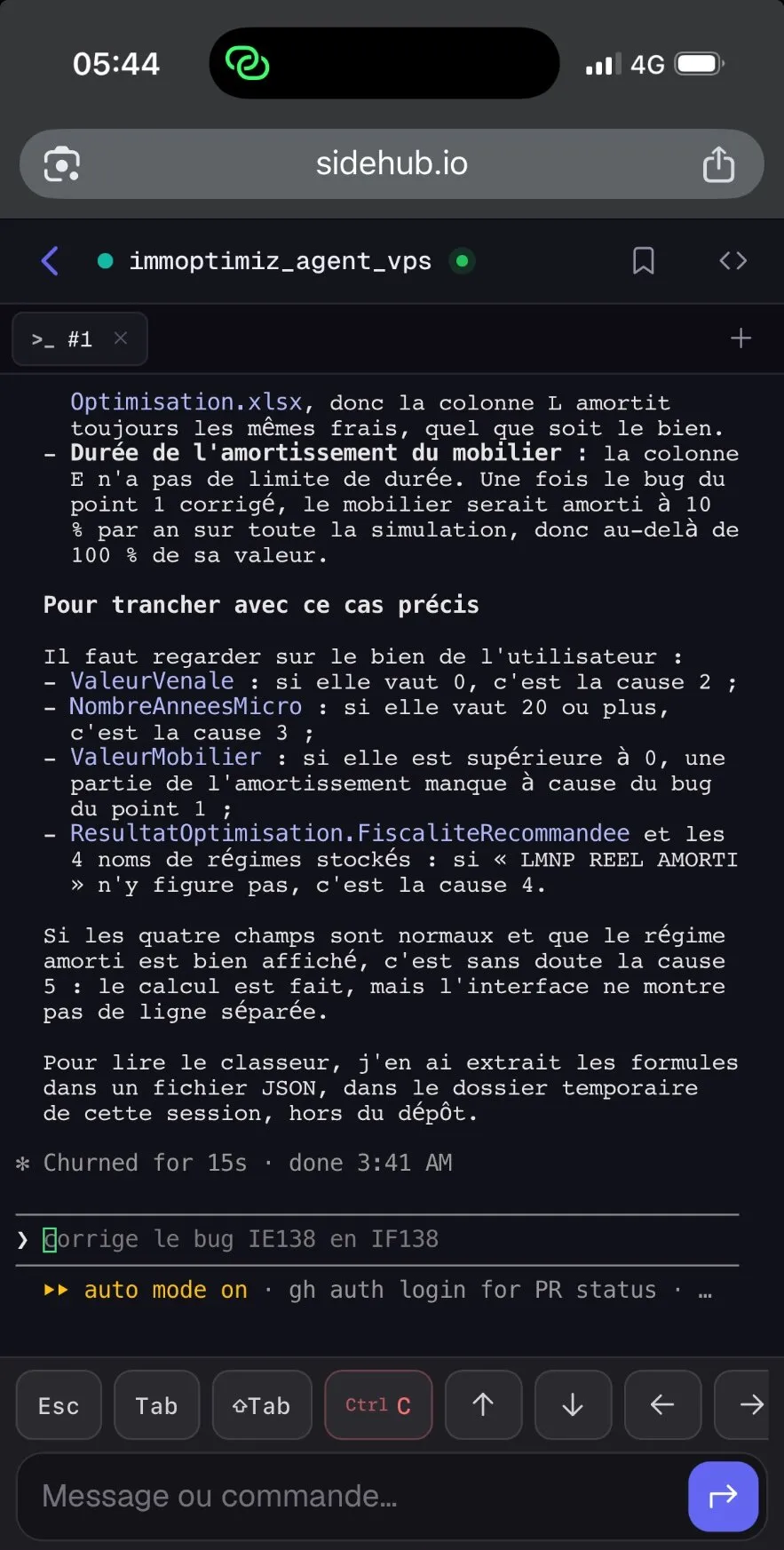
The scene, replayed for this screenshot: the end of the agent’s diagnosis, and the fix request typed from my phone.
This is the kind of moment I built SideHub for. Today, it does much more for me than vacation support.
One developer, six projects
I run six projects in parallel:
- SideHub, the cockpit that runs my coding agents, and its .NET agent
- Immoptimiz, the tax platform I co-own with my cousin
- @electrochoc.mind, a TikTok channel run 100% by agents
- a Stremio add-on that filters movies and series down to the ones already cached
- TheNextOne.tv, an app that helps you pick the next movie or series to watch
- this website.
Alone, that would be impossible. With agents, it works. Since January 2026, more than nine out of ten commits in these repositories are co-authored by an agent.
That number measures speed, not quality. A commit is neither a useful feature nor secure code. AI speeds up the writing, but I am still the one who validates what goes to production: quality, security, and whether it meets the right need. The work has changed shape, not owner. Here is how it is split.
One agent per repository
Each repository has its own agent. On my VPS, a small SideHub daemon runs per repository, started in the project folder. It connects to the backend over WebSocket and waits for work.
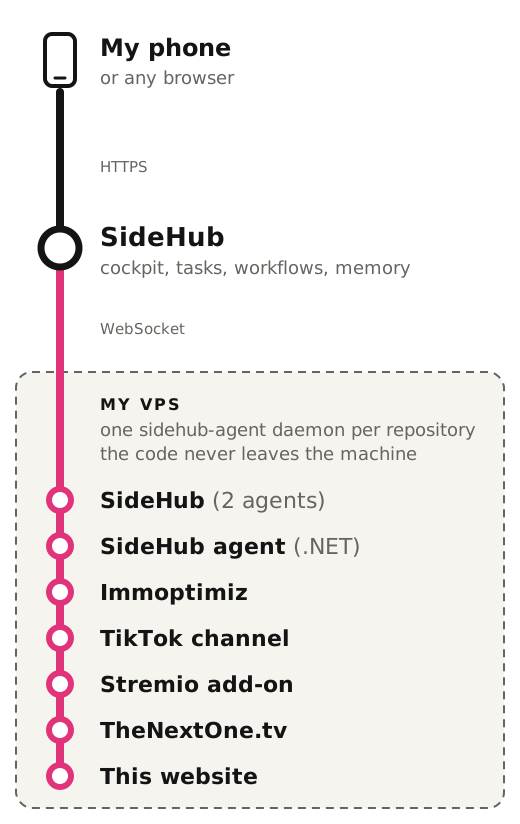
From any browser, phone included, I see all these agents in a single cockpit. I open the terminal of one of them, start Claude Code, Codex or Gemini CLI on the real repository, and I can close the tab: the session keeps running on the server. When I come back, the terminal history is replayed.
The cockpit is SideHub’s home page, and it tells me where each project stands. It shows the running sessions and which agent each one runs on, and I can join any of them in one click. Sessions waiting for an answer from me come first, with a notification after two minutes. It also shows the upcoming scheduled runs, workflow progress, the to-do tasks and the latest additions to the memory. With six projects, that is what saves me from keeping it all in my head.
The code never leaves the machine. SideHub only sees the terminal output, the statuses and the results.
Three ways to delegate
Over time, my usage settled into three categories.
The supervised session. I give an agent a task and follow its work, the way you follow a colleague in pair programming. It is my default for new features, when the need is not fully clear yet and I want to be able to steer along the way. TheNextOne.tv was built like that.
The workflow. For repetitive, well-defined work, I chain several agents, each with its own role, model and permissions. The workflow can be scheduled and run without me. That is how the TikTok channel works: five steps, three times a day, since May.
The question. Sometimes I do not need an agent to write code, only to read it. I ask the SideHub assistant a question in plain language (“how does Immoptimiz pick the recommended tax regime?”). It picks the right repository, that repository’s agent looks for the answer in read-only mode on the main branch, and the answer comes back a few minutes later with the files and lines that back it up.
SideHub builds SideHub
The project agents work on the most is SideHub itself. Two agents run on its repository. Since March, almost all of its commits are co-authored by an agent.
The loop is simple. When something bothers me while using SideHub, I turn it into a task, and an agent handles it inside SideHub. The next day, I use the fix. The question feature described above is a good example: SideHub’s agents built it in a single day, the very day I am writing this, and I already use it.
Being your own first user has a huge upside: every friction shows up right away. And a downside: I only see my own frictions.
What I keep for myself
If agents write most of the code, what is left? Quite a lot, actually.
- Deciding what to do. Agents execute a clear intent very well. They do not know whether billing on Immoptimiz comes before a new simulation, or whether a SideHub feature is worth it.
- Validating quality and security. Nothing goes to production without me reading it. An agent can write clean code that answers the wrong question, or let a security hole through without noticing. It writes fast, but I am the one who signs off.
- Talking to people. Discussing the billing model with my cousin, waiting for The Movie Database (TMDB) to allow me to use its data so I can release TheNextOne.tv: no agent unblocks those.
- Setting the rules. Every repository has an instructions file for agents: conventions, build commands, known pitfalls, even writing rules. The more precise it is, the less I fix afterwards.
That is the real lesson of the past months. The bottleneck is no longer writing code. It is choosing what to build, and where to put my attention across six projects. Agents multiplied how much I can produce. They did not multiply my thinking hours, and they take nothing off my responsibility for what I ship.
What does not work yet
- Agents are confidently wrong. A model that cannot find a piece of information tends to guess rather than say so. For the SideHub assistant, I had to write explicit instructions: search the repositories first, never invent internals, and only then admit it does not know.
- It is not free. SideHub measures the tokens of every run, and the cockpit’s Pilotage tab shows spend and tokens per day. Seeing what a workflow costs helps decide what deserves a large model and what a small one can handle.
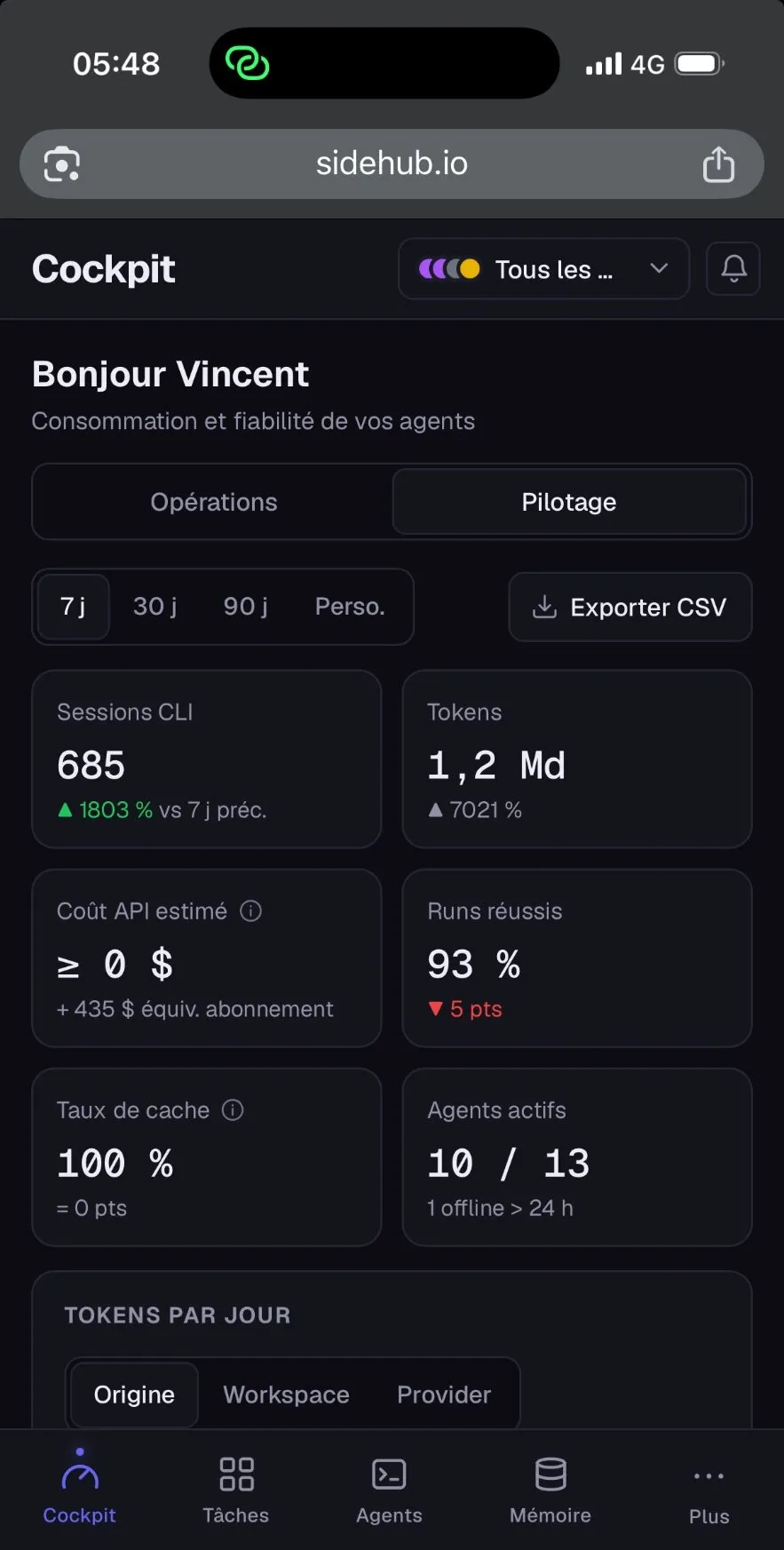
The cockpit’s Pilotage tab, over the last seven days.
Next departure: I am looking for testers
In the article about the TikTok channel, I wrote that I was SideHub’s only user. That is still true, but I would like it to change.
I built it for my own needs. I do not know yet whether it fits yours, and that is exactly what I want to learn. I am looking for a few people who look like I did a year ago:
- you run several projects, alone or in a small team
- you already use Claude Code, Codex or Gemini CLI every day
- you would like to follow your agents from your phone, let them work while you do something else, or chain them into workflows.
In exchange for your feedback, I will help you install your first agent and give you three months of the Pro plan. If that sounds like you, press the STOP button at the top of the page and tell me which projects you would like to try it on.