The Next One
An app that helps you pick tonight’s movie or series in thirty seconds, without scrolling through entire catalogues.
- Status
- Under construction
- Since
- 2026
- Role
- Founder
- Lines
- EntrepreneurAI
Choosing without scrolling
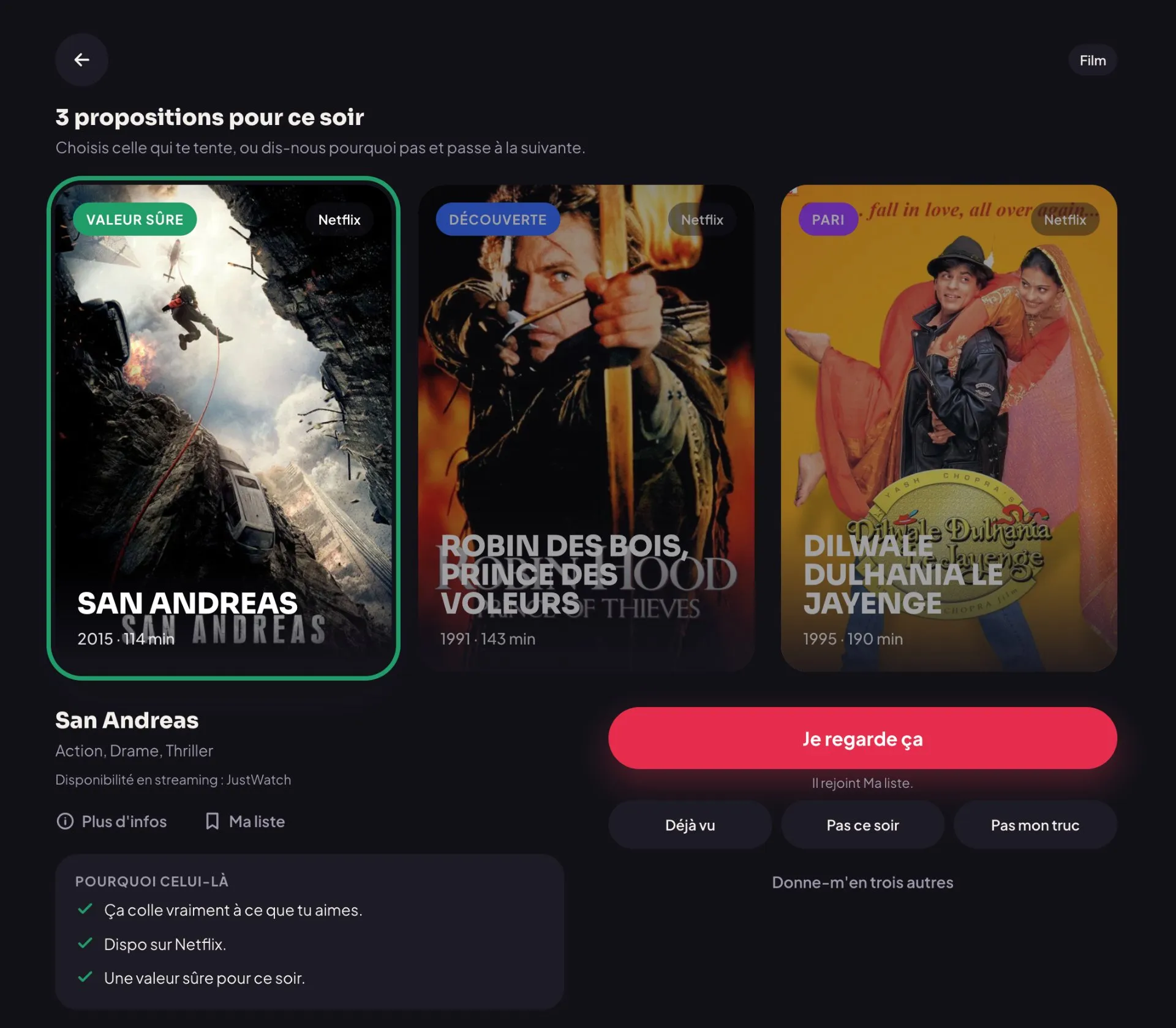
In the evening, we often spend more time looking for something to watch than watching it. Streaming platforms show hundreds of titles and keep pushing the same ones. The Next One turns the problem around. You say who is watching, whether you want a movie or a series, how much time you have and what you feel like (easy, funny, intense, dark…). The app then returns three picks, no more:
- Safe bet: a title you are very likely to enjoy.
- Discovery: a title a little outside your habits, without needless risk.
- Wild card: more surprising, but still plausible.
Each pick says why it was chosen, and the app only keeps what is available on the user’s platforms.
A taste profile that learns
To start, you sort a few well-known titles with one gesture (Nope, Like, Love or Not seen), or import your Letterboxd or IMDb history. The profile then learns the genres, themes and actors you love. Every answer to a pick refines it: “Already seen”, “Not tonight”, “Not my taste”. A well-rated series that “loses steam” even steers the engine towards miniseries.
You can also watch together. A partner invited by email adds their tastes to the evening, and the “with children” mode sets a maximum age rating for every pick. Finally, a personal Stremio add-on shows “My list” and “For you” right inside Stremio.
Jev, a model built to decide
To evaluate candidates, I use Jev, TypeSafe’s decision model. It is not a chatbot. It does not write text: you describe a situation, ask typed questions (yes or no, or a rating on a scale of levels), and it answers with probabilities and a confidence level. That is exactly what a recommendation engine needs: answers it can compute with, not paragraphs.
Each evening, the .NET backend shortlists about twenty candidates. For each one, Jev receives the evening and every viewer’s tastes, written the way a person would say them (“loved Arrival and Prisoners”) rather than as a count of genres. It then answers precise questions: will each viewer enjoy this title, will they turn it down, does it fit tonight’s mood, does it step outside their habits, could it be a good surprise?
A debug view, open to my account only, shows an evening’s whole journey: the candidates generated, those that pass the filters, the 24 Jev evaluates, the time each stage took, then for each title its scores and the request sent to Jev.
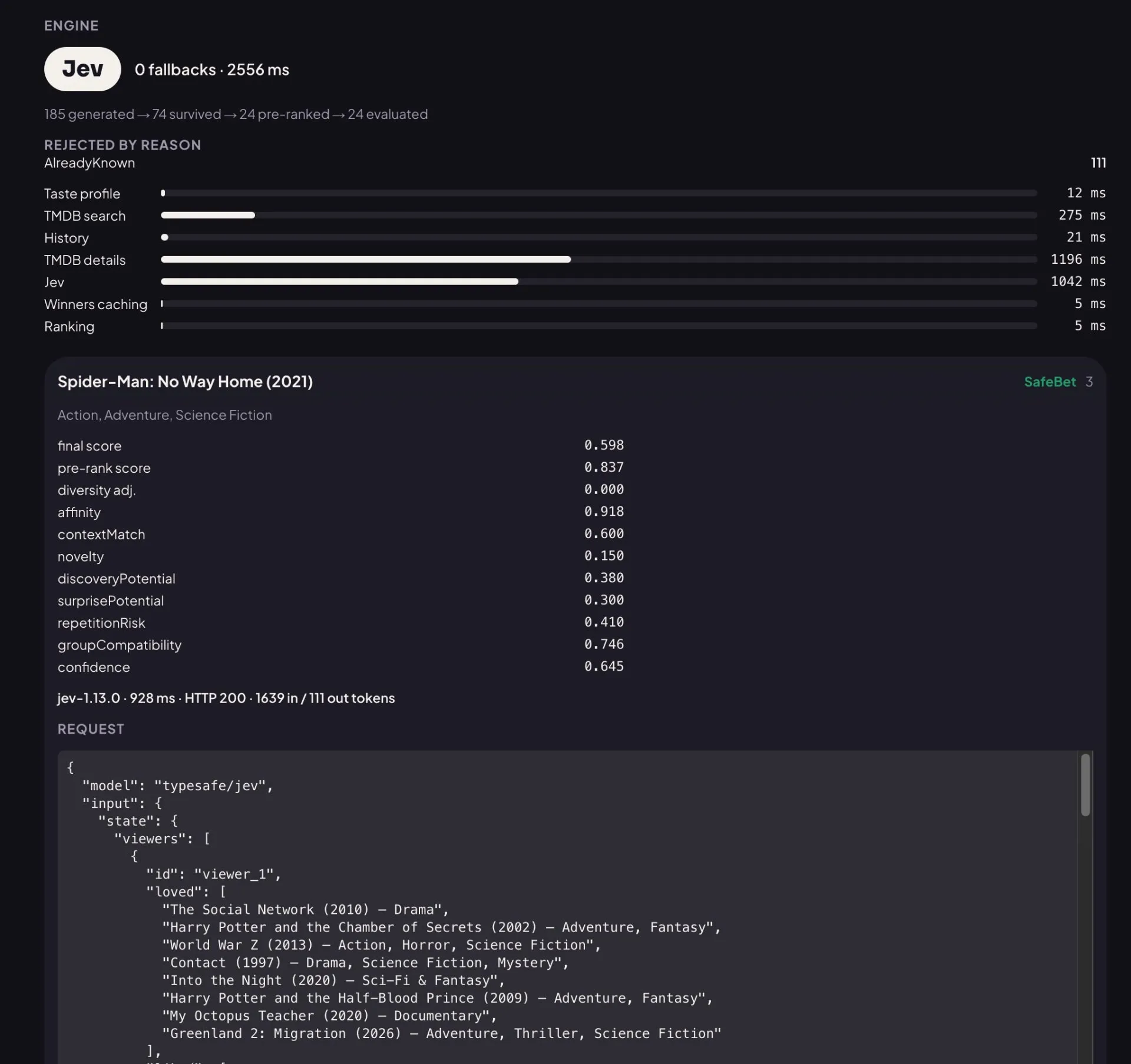
Jev has limits, and TypeSafe documents them: it reads literally, and it can neither count nor compare dates. So the code keeps everything that is arithmetic, such as runtime against the time available. A deterministic ranking in .NET then combines Jev’s answers and picks the three suggestions. That ranking keeps control of diversity and avoids suggesting the same genres over and over. If a call to Jev fails, the engine falls back to a backup score for that candidate only.
Jev runs through Cloudflare Workers AI, at $0.042 per million input tokens, with output not billed. Every call records its tokens and estimated cost, without keeping any content or taste. So I know what an evening costs, and what an active user would cost, before the service even opens.
Where the project stands
The app runs and I use it. Its public release is waiting for The Movie Database (TMDB), where the movie and series data comes from, to allow me to use that data with AI.
I built it in supervised sessions with agents run from SideHub: more than 500 commits in one month, nearly all co-signed by an agent.
Tech stack
- Angular
- TypeScript
- Tailwind CSS
- .NET 10
- ASP.NET Core
- Entity Framework Core
- PostgreSQL
- OpenTelemetry
- Cloudflare Workers AI
- Jev (TypeSafe)
- Docker
- Railway